
When Disaster Strikes – Part 2: Understanding “Like-for-Like”
- Jacob Flury
- Dec 27, 2025
- 3 min read

Disclaimer:All cost examples in this blog are hypothetical and do not reflect real pricing. Actual material and labor costs will vary by project, contractor, and location.
Start Here: Read Part 1 First
Before diving into this topic, we recommend reading “When Disaster Strikes – Part 1,” where we cover what Oregon homeowners can expect during the insurance claim process after experiencing water damage or other home disasters.
What “Like-for-Like” Really Means in Insurance Restoration
When your home is damaged and you file a claim, your insurance company follows a model called “like-for-like” coverage. This means they pay to replace damaged materials with items of comparable type, quality, and grade, based on today’s market value.
Imagine a 2000s kitchen with wood-stained cabinets and Formica countertops. After your adjuster completes their inspection, they’ll calculate the cost to replace that Formica—not with Quartz or another modern material, but with the current equivalent of Formica, even if prices have changed since the original installation. Insurance focuses on restoring what you had, not upgrading it.

How Homeowners Use This Process to Upgrade
Even though insurance won’t pay for modernization, the payment goes directly to you, which gives you freedom to choose different materials.
For example, if insurance values your damaged Formica at $2,000, and the Quartz countertop you want costs $3,500, the insurer still pays you the $2,000. You simply pay the $1,500 difference. Many Oregon homeowners use this moment—when work must be done anyway—as a cost-effective opportunity to renovate.
When Materials Are Outdated or Discontinued
Sometimes the material in your home simply isn’t made anymore. This is especially common with older kitchens where certain cabinet styles, door profiles, or woods are no longer produced. In these cases, insurance must consider functionality and uniformity.
If your island cabinetry is damaged but that exact style doesn’t exist today, replacing just the island would leave it mismatched from the rest of the kitchen.
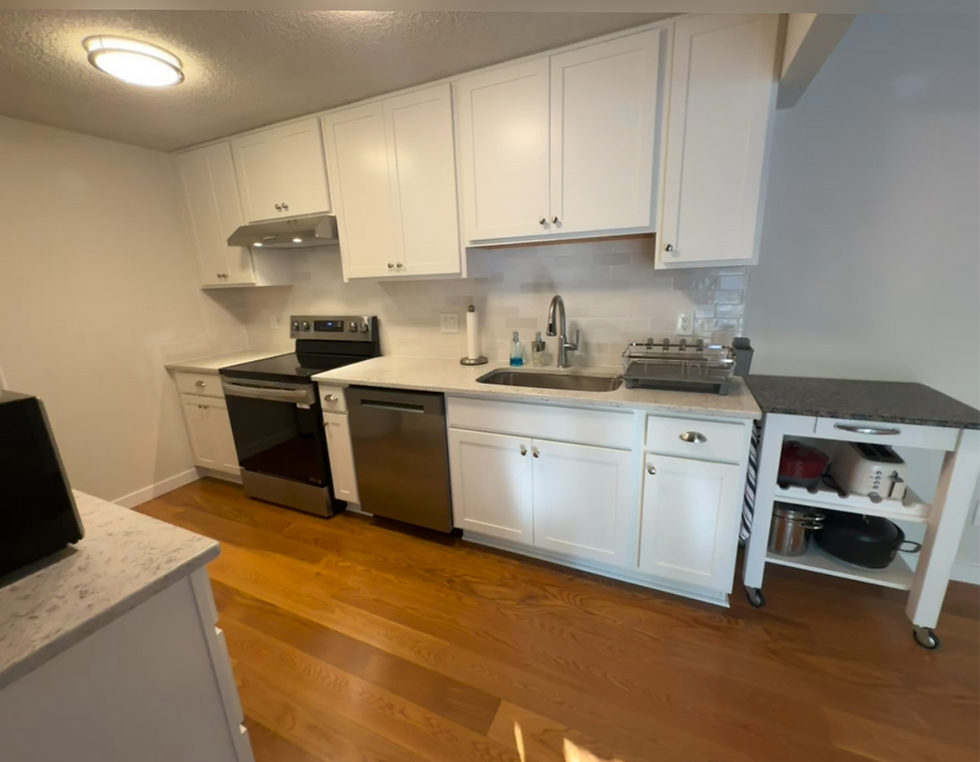
Insurance companies recognize this and will typically pay to replace all related cabinets so the space matches—still at a like-for-like valuation such as paint-grade for paint-grade, oak for oak or raised panel for raised panel (etc.). The goal is to keep the kitchen visually and structurally consistent.
Using Insurance Funds to Create Your Dream Kitchen
This situation is one of the biggest advantages of insurance-based remodeling. You’re already receiving funds for necessary replacement, so you can often upgrade to higher-end materials at a much lower out-of-pocket cost.
For example, if your oak cabinets are valued by insurance at $10,000, but you want new ash cabinets priced at $12,000, insurance still pays the $10,000. That means you only cover the remaining $2,000. Many Oregon homeowners use this approach to achieve a kitchen they may not have otherwise invested in without the insurance claim.
Summary
Dealing with unexpected home damage can be stressful, but understanding the insurance claim process makes it more manageable. As the homeowner, you are the primary contact with your insurance company, while a trusted contractor—like Edelweiss Construction—serves as your guide and partner throughout repairs. Insurance pays for like-for-like replacement of damaged materials, but you can use the payout to partially fund upgrades or modernizations. Being aware of regional cost differences, documenting all work, and planning carefully can help ensure your home is restored efficiently—and even give you the opportunity to create your dream kitchen or space at a lower out-of-pocket cost.


Comments